India’s Consumer Stack Explained: What Every Entrepreneur Should Know!
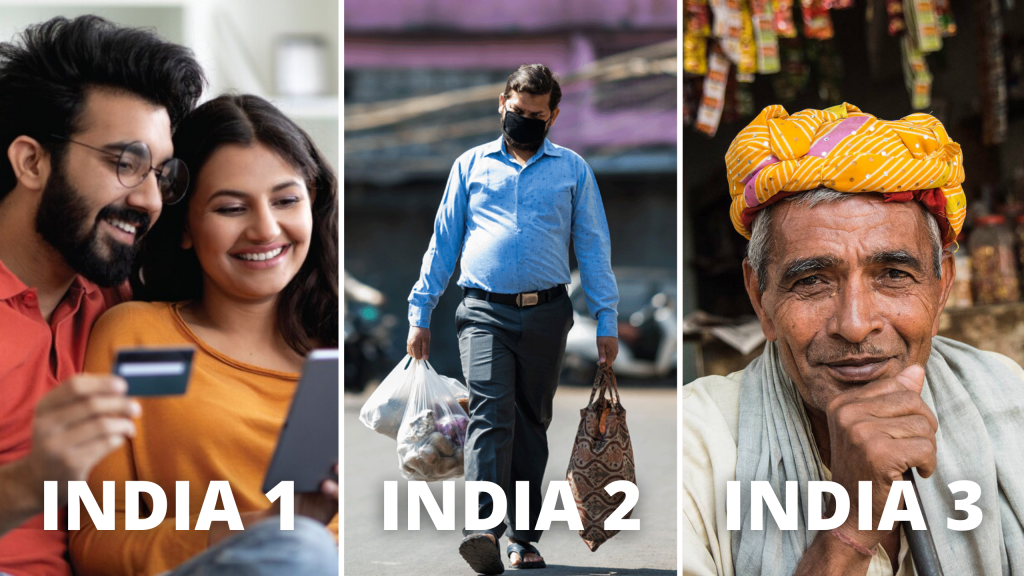
How India sees India? Indians usually fit themselves in three classes based on their income and the per capita income of India- How an Entrepreneur sees India The consumers are the most significant part of any Startup- cracking the consumer psychology can make or break any Startup into the another failed venture or the next Zomato. Although the above classification divides the Indians into fell-fit segments, it isn’t much profitable to an Entrepreneur as it is based on the income of an individual rather than the consumption. For an Entrepreneur, analyzing consumer behavioral trends, shifts in consumer mindset, and differentiating consumers based on consumption patterns is extremely important to crack the Product-Market Fit (PMF) for their product. India One-Two-Three Kishore Biyani, an Indian entrepreneur and founder of successful consumer brands such as Pantaloons and Big Bazaar, first introduced the thesis of India 1, 2, 3 in his book “It Happened in India” where he classified Indian consumers based on their consumption patterns into 3 categories. Later, The Blume Ventures, a venture capital firm, issued a report “The Indus Valley Report” about the Indian market and consumer trends after analyzing and compiling insights from founders like Kishore Biyani, Harish Chawla and Sharad Sharma. They introduced the concept of India’s Consumer Stack In a 2018 report by Sajith Pai, He considered each segment as a separate geographical unit and compared it to countries with similar market and consumption. India 1 (The Consumers) : Mexico India 2 (Aspirants) : Indonesia India 3 (Unmonetizable) : Sub-Saharan Africa We can further understand this relation by the following table provided in a 2018 report. (The following data maybe according to 2018 stats but the fundamental consumption ration is still relevant today.) Further more Sajith Pai identified another tiny chunk of ultra-premium consumers, who were the 10% of the 110M people of INDIA 1- the INDIA 1 ALPHA or INDIA 1A. This break down of India on the basis of consumption enabled startups to effectively place their services or products in the most promising segments and made it easier to understand the needs of the particular customer base. Where it all Starts! Statistically 10% of Indian consumers contribute to 50% of the consumption in India. These 10% are the INDIA 1 consumers. How to identify them- Startups primarily target India 1 due to its affluent consumer base, leveraging high disposable incomes and digital engagement. Success in this segment often facilitates expansion into the larger, price-sensitive India 2 market. Zomato, a food delivery platform, targeted India 1 consumers by offering a convenient, reliable food delivery experience, leveraging their digital engagement and willingness to pay for quality service. This strategy allowed Zomato to establish market leadership before expanding to the price-sensitive India 2 segment, where it competes on both convenience and cost. INDIA 1 Economies Kishore Biyani, in WTF podcast by Nikhil Kamath, further segregated INDIA 1 in three different economies. Out of the 120M people in INDIA 1: 5% reflects Singapore, 28% – Poland and the remaining 67% -Mexico. This chart prominently depicts the Ultra-premium INDIA 1A. Stay connected to learn more about INDIA 1A- Their consuming habits and how to make the most from them. The Next Million $ Market INDIA 2.1 (The Emerging Class) As the income levels in India rise, there is a noticeable shift in consumer behavior towards premium brands and products. The market share of these premium offerings is increasing, while entry-level or basic products are experiencing a decline. With more disposable income, consumers previously categorized as part of “India 2” are now transitioning to the “India 1” demographic, Forming a new Emerging class or the INDIA 2.1. This phenomenon gave rise to a new economy which is growing rapidly with growing population each coming year. In the Indus Valley Report, Blume Venture compared the consumer market of INDIA 2.1 to that of Brazil. They have a new set of consumer beliefs and are the next million dollar market. You can understand these points in more depth by going through Sajith Pai’s 2018 report: India2, English Tax and Building for the Next Billion Users and you can also refer The Indus Valley Report By Blume Ventures. Citations An excellent conversion which really got me interested in this framework